Sign In
Upcoming Event
 Free Newsletter

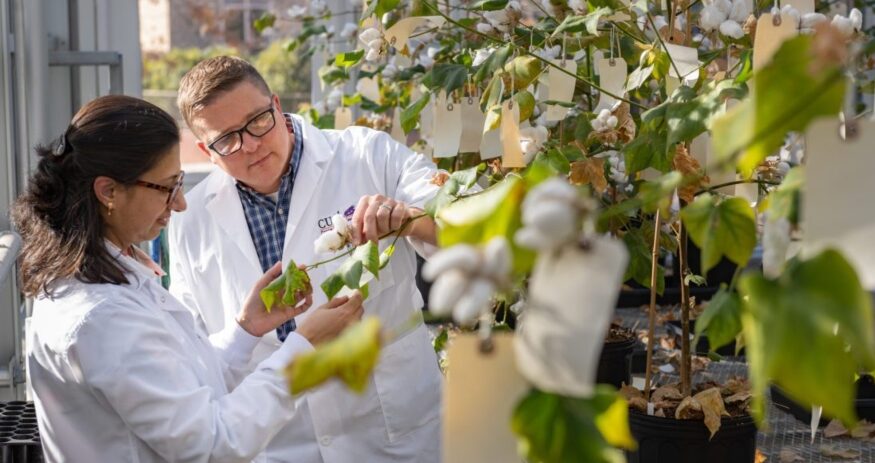
Clemson researchers are developing next-generation cotton designed to reduce environmental impact and improve performance. (Photo/Clemson University)
Clemson researchers are developing next-generation cotton designed to reduce environmental impact and improve performance. (Photo/Clemson University)
Clemson wins $11M Bezos grant for sustainable cotton research
Staff Report // May 1, 2026//



- Clemson University awarded $11 million Bezos Earth Fund grant
- Research focuses on sustainable cotton using gene editing and synthetic biology
- Goal is to reduce water use, chemicals and environmental impact
- Project could boost South Carolina’s cotton industry and global textile innovation
Researchers at Clemson University are rethinking cotton from the ground up.
What we wear carries an environmental cost long before clothing reaches a store shelf, the researchers say. From water-intensive dyeing to chemical processing and waste, the materials used in fashion have a major impact on natural resources. That’s what the researchers want to change.
With an $11 million grant from the Bezos Earth Fund, Clemson scientists led by Christopher Saski, systems geneticist and professor in the Clemson University Department of Plant and Environmental Sciences, will advance research aimed at creating cotton that performs better, uses fewer resources and opens new possibilities for growers, manufacturers and consumers.
“Clemson University is proud to be a part of shaping the future of global agriculture and the fashion industry through bold innovation and advancing groundbreaking research,” Robert H. Jones, Clemson University interim president, said in a news release. “Dr. Saski’s cutting-edge research in the fields of gene editing and synthetic biology has the potential to positively impact the lives of every person on our planet, which is a testament to the work we do every day at Clemson University and to fulfilling our unique land-grant mission of education, research and service.”
For South Carolina, where cotton remains an important part of the agricultural economy, the work could help strengthen a legacy crop while positioning the state at the forefront of sustainable textile innovation.
The project will combine gene editing, synthetic biology and advanced breeding to develop next-generation cotton with built-in color, improved performance and greater resilience. Instead of adding those traits later through resource-intensive manufacturing, researchers are designing them directly into the plant, the release stated.
The approach could reduce water use, lower chemical inputs and create fibers better suited for modern manufacturing. It could also help growers by increasing the value and versatility of cotton in a rapidly changing global market.
Collaborators from the University of Georgia are also part of the team. The project builds on Clemson’s advances in cotton transformation and eco-friendly fiber coloring.
“This work focuses on growing fibers that are inherently better for the planet by moving color, performance and resilience into the biology of cotton itself,” Saski said in the release. “This approach flips the traditional model that has been used for more than a century to build a future of sustainable fashion, and we’re excited to have support from the Bezos Earth Fund to help us move this research forward and further.”
The Bezos Earth Fund is investing in new approaches to the materials used in clothing, an industry with a significant environmental footprint, including greenhouse gas emissions, water use, pollution and waste. Clemson researchers say addressing those challenges starts with rethinking how fibers are grown and produced.
For the Clemson team, the grant represents an opportunity to turn scientific discovery into practical solutions with impact beyond the lab. From South Carolina farms to global supply chains, the work could help shape a more sustainable future for one of the world’s most widely used natural fibers, the researchers said.
s